Skip to content
Soulfully handmade · uniquely crafted. Made in low-volume runs. Accents of Me — now in studio

Why We Started with Accessories

A clothing range is an expensive first sentence. You commit to a size curve, a fit block, a fabric minimum and a season, and you find out whether any of it was right roughly nine months after you decided.

A fabric neck piece is a cheaper, faster and far more honest first sentence. It carries the whole aesthetic — the wrapped textile, the earthy palette, the handcrafted irregularity — in a single object that costs a fraction to sample and rotates in weeks rather than seasons.

It also photographs. Accessories are the most Instagrammable part of a wardrobe because they sit at the face, and because they change an outfit someone already owns. Every neck piece we sell is a styling argument made on somebody else's clothes.

So the roadmap is deliberate. Phase one is fabric jewellery, wristbands and charms, then scarves, carry-ons and journals. Phase two is soft apparel, opened only once the accessory identity is established and people already know what Raw Twig looks like from across a room.

The strategy is not modesty. It is lower inventory risk, a faster cash cycle, higher social impact and stronger margins — with brand recall built from day one rather than year three.

The Beads Were Something Else First

Textile jewellery sounds like a craft technique. In practice it is a sourcing problem first and a craft technique second.

The floral cottons, bandhani ribbons and block-printed scraps that become our beads do not arrive on a roll. They come from end-of-run lots, sample lengths, old quilt tops and the offcut bins of block printers in Rajasthan and Gujarat — a metre here, four there, never repeatable.

Each piece is cut into a strip, wrapped over a wooden core, tucked and stitched closed by hand. A single bead takes a few minutes. A layered strand takes most of an afternoon, and the maker is choosing colour relationships the whole way along, because no two source fabrics are the same.

This is why the badge on some pieces reads one of one and means it. We can make more Kantha Bead Neck Pieces. We cannot make that one again.

It is also why the collection reads as collected rather than designed. The palette holds together — terracotta, olive, indigo, sand — because the sorting happens at the table, by eye, before anything is strung.

Kantha: Stitching Cloth Back Together

Kantha began as repair. Worn cotton saris and dhotis were layered, and a simple running stitch was worked across the whole surface to bind them into something warm enough to sleep under. The stitch was structural. The pattern it left was a by-product.

We use it the same way. In the Kantha Patchwork Stole, squares of reclaimed cotton are pieced edge to edge and then quilted across with running stitch in a contrast thread — which is what stops a pieced cloth from pulling itself apart at the seams the first time it is wrapped twice around a neck.

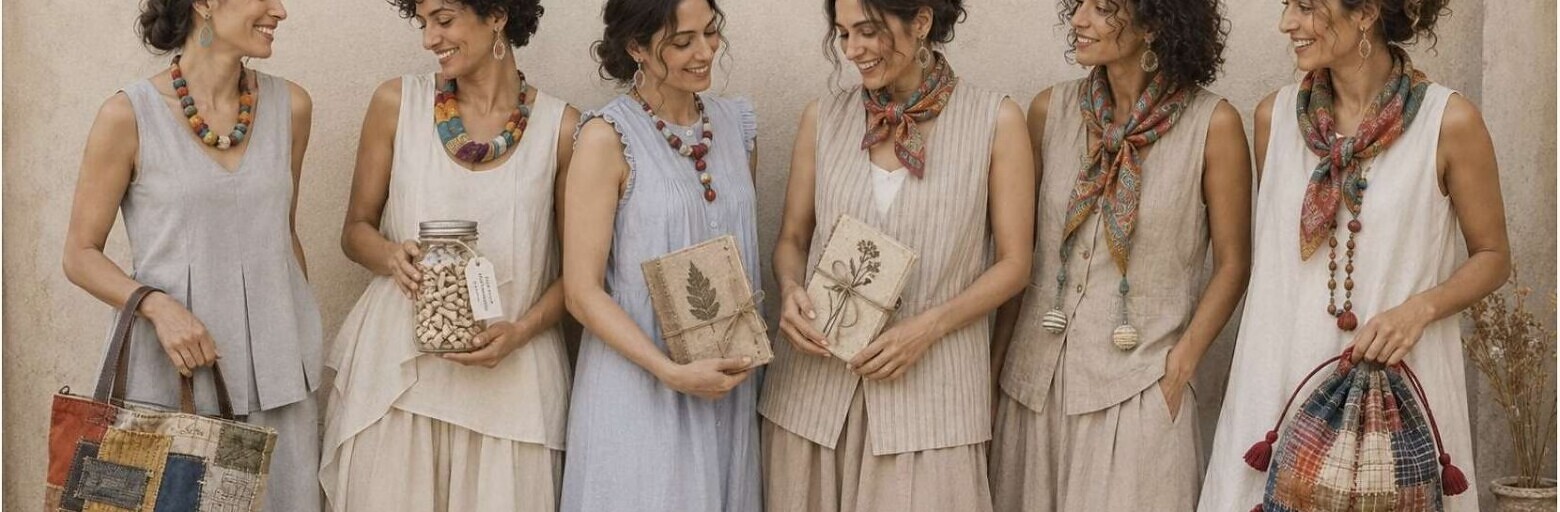
In the totes, the same stitch does heavier work. Raw-edge patches are laid over a canvas base and top-stitched down in rows. The edges fray for the first few weeks, then stop, because the stitching has caught the weave.

Nothing about this is fast. A stole takes days of stitching and the arrangement of the patches is decided piece by piece, so no two ever match. We have stopped describing that as a limitation in our product copy, because it is the reason people buy them.

The texture deepens with use. The frayed edges soften, the thread beds in, and the cloth ends up looking more like itself the longer it is carried.

Caring for Textile Jewellery

The most common way a textile neck piece is ruined is water. The beads are cloth wrapped over a wooden core; soak them and the core swells, the wrap loosens, and the shape never fully returns. Never wash a piece, and take it off before you swim or shower.

The second is perfume and oil. Spray scent first, let it dry, then put the piece on. Oils darken light cotton unevenly and the mark does not lift out of a stitched bead the way it would out of a flat fabric.

The third is storage. Hang neck pieces or lay them flat rather than dropping them into a drawer where the cords tangle and the beads press against each other. Direct sun over months will fade a bright block print, so keep them out of a window.

For everyday marks, spot clean only: a barely damp cloth, no soap, dabbed rather than rubbed, then air dry away from heat.

Done this way the piece will soften and settle rather than wear out — which is what we designed it to do.

Who She Is

On paper she is between twenty-eight and fifty-two, and lives in Mumbai, Delhi, Ahmedabad, Bangalore, Pune, Hyderabad or Goa. That description is accurate and tells you almost nothing.

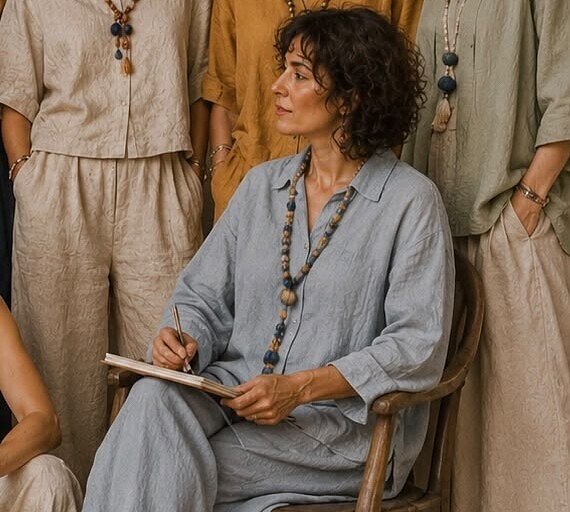
What actually connects our customers is a way of assembling an outfit. She is emotionally expressive, creatively inclined, culturally aware and aesthetically evolved. She buys objects rather than trends, and she remembers where each one came from.

She is often an architect, an artist, an interior designer, a stylist, a therapist, a professor, a writer, a gallery professional, a wellness founder — someone whose work is visual or expressive, and whose clothes are read by other people as part of that work.

She does not need a new wardrobe every season. She needs one strong object that changes the six things she already owns, which is exactly what a neck piece or a stole does.

That is why we are experience-oriented rather than occasion-oriented. Nothing in this range is designed to be worn once.

A Space to Slow Down

A journal is not obviously a fashion product. It does not sit on the body, it cannot be styled, and nobody sees it. We made them anyway, and they have become the pieces people write to us about.

The materials are the same conversation as the rest of the collection: handmade paper with deckled edges and visible flecks, covers of embroidered linen or corrugated kraft, pressed wildflowers set under a layer of fibre paper, bound with jute rather than glue.

The Letters to Self Jar goes further. A hundred blank scrolls in a glass jar with a hand-written tag — you write one, roll it back, and open it a year later. It is the least commercial thing we make and the one we are most attached to.

What ties it to the clothes and the jewellery is the same instruction: slow down, be present, and create from what is real, raw and rooted within. The neck piece says that outwardly. The journal says it to you.

Made with nature. Made with intention. Made to be yours.